

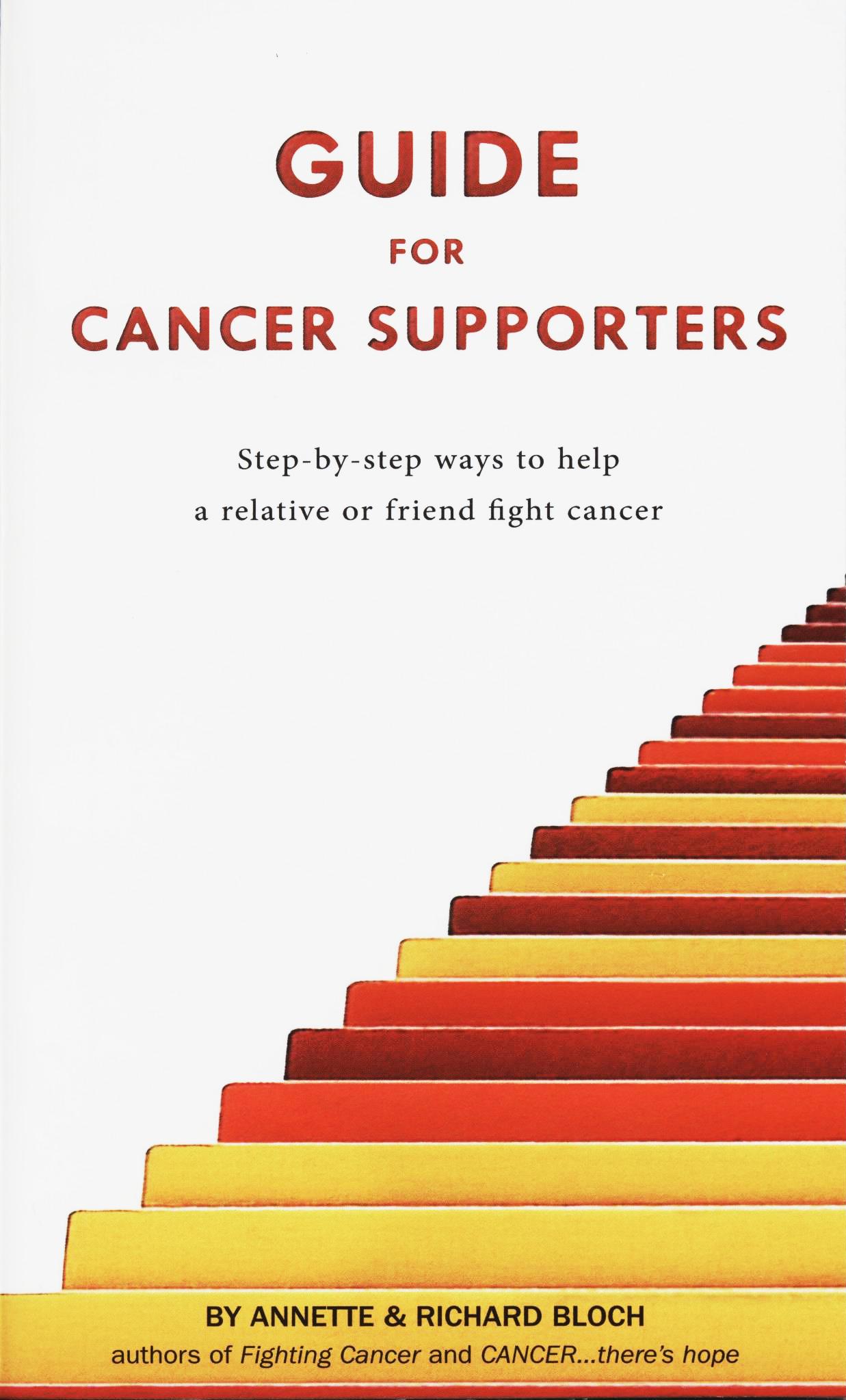
Guide for Cancer Supporters (2nd printing 1995) was written by Annette and Richard Bloch, co-founder of H & R Block, Inc. Richard was diagnosed with ‘inoperable’ lung cancer in 1978 and told he had 90 days to live. After 2 years of strenuous treatments he was completely cured. He and his wife, Annette, wrote this step-by-step guide to help you help your relative or friend fight cancer. This book is written to help you understand the facts about cancer, its probable effects on the patient and their likely reactions to the diagnosis. This will enable you to better fill the needs of the patient, whether your relationship is casual or you are the primary supporter or somewhere in between.
When cancer is diagnosed, it is not only the person diagnosed who experiences concerns about the future – but also the relatives and friends. In fact, studies have shown that levels of distress are just as high in the next of kin as in the patient! That is why we think of cancer as a “family” disease and recognize that support is needed by the family members as well as the patient. Other studies show that helping the spouse of a cancer patient cope better has a substantial effect upon the patient’s ability to cope and can work like a “ripple” effect.
The best way to counter that initial overwhelming fear which accompanies a diagnosis of cancer is to get the best information available about cancer and its treatment and to begin to cope with the psychological impact. The need for commitment to a course of positive action is an important way of beginning to cope.
“What can I read?” is an increasingly common question. Advice for the caring family and friends has been sparse but this valuable little book begins to fill the gap. It carries the added weight of having been written by the Blochs who speak with the voice of experience – and who share “how it felt” to be given a three month prognosis. The commitment to finding treatment and not giving up is a success story we all benefit from today.
Part I is a powerful review of the “what it feels like” of cancer. Written for the healthy spouses of patients it gives important practical advice about helping the ill spouse. An important message is the value of providing support and access to good information, but not at the expense of taking the decision making away and respecting the person’s individuality and need for independence. We live in an era when some books suggest there is only one correct way (their way) to face cancer and those who don’t are doomed. The Blochs encourage respect for each person’s coping style and their right to use it. The spouse is an important force in making the patient feel guilty for not using a particular method, or in feeling empowered and confident because they feel supported by their spouse in their handling of their cancer.
More attention to “helping the helper” is needed and hence, the value of this book, especially for spouses. The spouse must simultaneously support the patient, manage the home and family, make the living, manage the insurance forms, arrange visits to the doctor, share discussions about cancer, and answer all the well-meaning calls asking “How is Joe?” but rarely, “How are you?” The strains, borne without much recognition or praise, are difficult. More of our efforts must be directed to assure the spouse copes, since so much rests on the healthy adult. The Well Spouse foundation is a self help organization which has developed out of awareness of this need.
Part II is an excellent brief introduction to cancer therapies which is useful as one hears these words for the first time in a personal context.
Part III is directed to the casual friend who suffers from “Do I visit my friend with cancer?” “What do I say?” “Will it be the wrong thing?” Advice to reduce self-consciousness and affirmation of the need to keep ties which antedate the onset of cancer comes through clearly in this practical guide.
Last, biographies sometimes tell more than all the “do as I say” advice reveals. Dick Bloch’s biography is a powerful “call to arms” at the book’s end, sharing how one couple coped and won. It is well worth emulating!
Jimmie C. Holland, M.D.
Director, Psychiatric Oncology
Memorial Sloan-Kettering Cancer Center
| Available eBook Reading Format (FREE) | Full Book |
|---|---|
| Online Reading (HTML, good for sampling in web browser) | View |
| Kindle (.mobi for Kindle devices and Kindle apps) | Download |
| Epub (Apple iPad/iBooks, Nook, Sony Reader, Kobo, and most e-reading apps including Stanza, Aldiko, Adobe Digital Editions, others) | Download |
| PDF (good for reading on PC, or for home printing) | Download |
| RTF (readable on most word processors) | Download |
| LRF (Use only for older model Sony Readers that don’t support .epub) | Download |
| Palm Doc (PDB) (for Palm reading devices) | Download |
| Plain Text (download) (flexible, but lacks much formatting) | Download |
| Plain Text (view) (viewable as web page) | View |